

Despite the recent uptick in stock prices, the trend in interest rates is concerning.
The 10-year Treasury yield touched 4.747%, right around its highest level in the last 20 years. The 10-year reached 4.9% in 2023 and 5.0% before the Great Financial Crisis in 2007. The 30-year reached 5.274%, a 19-year high last seen in July 2007.
The Treasury market sets part of the price of almost everything you own. It influences mortgage rates, corporate borrowing costs, bond prices, and the rate investors use to value future corporate profits.
When yields rise, existing bond prices fall. Borrowing becomes more expensive. And the distant profits supporting expensive growth stocks become less valuable today.
The bond market has two things weighing on it right now. The first is domestic: investors are questioning whether the Federal Reserve is doing enough to control inflation. The second comes from abroad: Japan's effort to defend the yen may require it to mobilize part of the world's largest foreign Treasury position. We don't yet know how many Treasuries Japan actually sold — but its intervention landed at exactly the moment the U.S. bond market was already losing patience.
The Treasury market sets part of the price of almost everything you own. It influences mortgage rates, corporate borrowing costs, bond prices, and the rate investors use to value future corporate profits.
Why 5% Matters to Your Portfolio
The 10-year Treasury yield is one of the market's most important hurdle rates — the return threshold every other investment gets measured against. It shapes mortgage rates, corporate borrowing costs, and the rate investors use to discount future corporate profits back into today's dollars.
When the 10-year rises, three things happen at once: existing bond prices fall, financing gets more expensive across the economy, and every distant dollar of expected corporate profit becomes less valuable today. That last point matters most for expensive growth stocks — a large share of their value depends on profits investors expect years from now, and the higher the discount rate, the less those future profits are worth in present dollars.
A 5% 10-year rate is not a guarantee of future economic problems, but it puts pressure on all financial markets. At a 5% Treasury yield, investors can earn a meaningful return without accepting corporate earnings risk at all. That forces expensive stocks to offer a more convincing growth story — or a lower price. Government bonds compete more aggressively with stocks for investor dollars, housing affordability deteriorates further, and high-multiple companies have much less room to disappoint.
The historical parallel is useful if held carefully: the 10-year also touched 5% in October 2023, when the S&P 500 was near a five-month low, and stocks rallied hard once yields retreated. That was a correlation with several contributing causes, not proof that 5.00% exactly is some mechanical trigger for a selloff — but it's the same test the market is running again.
The Bond Market Was Already Revolting
The more important cause of Friday's Treasury selloff was domestic, not Japanese. The Fed held rates steady this week despite three officials preferring a quarter-point increase. In response, short-term yields fell while long-term yields rose. In this case, the front end of the yield curve was pricing less additional Fed tightening, while the long end demanded more compensation for the inflation risk of holding debt for decades.
In plain English, the market was saying: the Fed may not raise short-term rates enough, so investors want more compensation for holding long-term bonds exposed to inflation. That's a credibility warning. Japan didn't create it. Japan may have simply arrived at exactly the wrong moment.
The Bond Investor's Case Against a Silent Fed
A bond vigilante is an investor who sells government bonds because they believe fiscal or monetary policy is too loose. That selling pushes yields higher, tightening financial conditions even when the central bank does nothing. The vigilantes don't literally set the Fed's policy rate. They can set the borrowing rate the rest of the economy actually feels.
Fed Chair Kevin Warsh has largely abandoned the forward-guidance crutch — the hints about the Fed's next move that prior chairs leaned on. Three voting officials — Cleveland's Beth Hammack, Dallas's Lorie Logan, and Minneapolis's Neel Kashkari — wanted a quarter-point hike. The Fed held anyway, 9-3, keeping the target range at 3.5%-3.75% for a fifth consecutive meeting. The long end sold off anyway.
The inflation backdrop makes the hold harder to defend.
Japan's Currency Defense
Japan is the largest foreign holder of U.S. Treasury securities specifically, at roughly $1.14 trillion as of the latest available monthly data — its broader foreign-exchange reserves are larger, with Treasuries making up a substantial share. Japan does not necessarily need to dump Treasuries to obtain dollars: it can draw down dollar cash, sell other dollar assets, or borrow dollars against Treasury collateral through a Federal Reserve facility built for foreign central banks, which lets it raise dollars without selling a single bond.
That means we don't actually know how much long-duration Treasury paper, if any, Japan sold outright Friday. It's a potential source of pressure on the world's largest bond market — not a confirmed cause of last week's selloff.
The honest conclusion is that the U.S. bond market was already questioning the Fed. Japan may have just added to the pressure.
What This Means for Stocks
Growth stocks rebounded on Friday and Monday, but higher bond prices will put downward pressure on tech stocks in particular. If rates pause at these levels and then turn lower, that would be a good thing.
When inflation and interest rates rose in 2021 due to Covid driven inflation, growth stocks began falling in November of 2021, preceding the bear market of 2022. The S&P 500 declined 25% in 2022 and the Nasdaq (tech) fell by 34%.
Oil prices are not making much sense now, but the recent decline back to $80 per barrel is good for stocks and inflation.
These recent moves illustrate why I am not a believer in bonds as an investment. In 2026, bond prices have declined between 3% and 8% depending upon the duration. The risk of loss combined with low rates of return is not a good tradeoff.
Stay Disciplined My Friends,
Phil
Disclaimers The Beyond Buy & Hold newsletter is published and provided for informational and entertainment purposes only. We are not advising, and will not advise you personally, concerning the nature, potential, value, or suitability of any particular security, portfolio of securities, transaction, investment strategy or other matter. Beyond Buy & Hold recommends you consult a licensed or registered professional before making any investment decision.
Investing in the financial products discussed in the Newsletter involves risk. Trading in such securities can result in immediate and substantial losses of the capital invested. Past performance is not necessarily indicative of future results. Actual results will vary widely given a variety of factors such as experience, skill, risk mitigation practices, and market dynamics.
Some people really enjoy researching and picking individual stocks.
Trying to identify the next Amazon or the next Apple or the next Nvidia is very tempting.
If you follow the stock market, you will read about individual stocks that grow by over 50% in a year or over 100% in a year.
In 2026, some of the big semiconductor stocks have grown by more than 100% in just six months.
Picking one of these winners feels so good – a similar feeling to winning the lottery.
Winning money triggers a massive release of dopamine in the brain's reward center. And the brain’s reward center releases more dopamine when the outcome is uncertain.
THE ODDS
Unfortunately, the odds of picking winning stocks are very low.
Most active fund managers fail to outperform the broad stock market index funds over time. Less than 5% of highly paid, super smart, experienced professional investors can beat the market over ten years. That number drops to less than 2% when we go out 20 years or more.
Do you think you can do better than the best money managers who have access to more and better resources?
THE DATA
The odds are stacked against investors because stock market returns are not evenly distributed; a small handful of "mega-winners" generate all the market's wealth, while the majority of individual stocks underperform.
Studies on long-term stock returns show that nearly 69% of individual stocks fail to keep up with the overall market, and over half actually lose money over their lifetimes.
A tiny number of massive winners pull the whole stock market higher. All of the net wealth created by US stocks over nearly a century is attributable to about 4% of them. The other 96% collectively matched the return of one-month Treasury bills.
THE TIMING CHALLENGE
Even if you were lucky enough to identify more winners than losers, you will only make money if you buy at the right price and sell at the right price.
The entire stock market is volatile – gaining over 20% in some years and losing more than 20% in other years.
Individual stocks are much more volatile than the stock market as a whole. In any given time period, you can find stocks that drop by more than 90% and stocks that gain more than 100%.
The S&P 500 gained about 10% in the first half of 2026, yet some big names lost well over 50% (Lululemon, Fiserv, TradeDesk, Deckers Outdoors).
Thirteen of the S&P 500 stocks have gained more than 100% this year. Sandisk gained over 500% in the first half.
Yet, if you bought some of the high flying tech stocks a month ago, those stocks have dropped by over 20% in the last 30 days.
Not only is it super difficult to identify the winners, it is very hard and takes tons of discipline and skill to buy and sell at the right time. Knowing when to sell a winner is the key to making money with individual stocks.
BUY THE HAYSTACK
Rather than trying to find the needle in the haystack, the better strategy is to buy the haystack.
When you own broad market index funds, you own the haystack.
The S&P 500 index consistently gains an average of 10% per year over long periods of time. The Nasdaq-100 posts gains of 14% per year.
The average investor only gains about 5% per year, so generating gains of over 10% per year is excellent – enough to beat the professionals on Wall Street.
GET RICH SLOW
To some people, getting rich slowly by gaining 10% per year is boring. So, what’s the answer for these folks?
I work with many retirement investors who are drawn to stock picking. They like to do it. It is a hobby for them. It is fun for them.
I also work with people who are drawn to investing in cryptocurrencies like Bitcoin.
The good news is that you can do both – get rich slow and scratch the itch to speculate.
For these people, I recommend that they take 5% of their portfolio and dedicate it to get-rich-quick schemes. Even if they lose all of those dollars, it won’t hurt them too much.
You can ensure excellent long term returns and a healthy financial future by investing the majority of your portfolio in the best performing index funds and you can satisfy your need to speculate with a small portion of your portfolio.
Stay Disciplined My Friends,
Phil
Disclaimers The Beyond Buy & Hold newsletter is published and provided for informational and entertainment purposes only. We are not advising, and will not advise you personally, concerning the nature, potential, value, or suitability of any particular security, portfolio of securities, transaction, investment strategy or other matter. Beyond Buy & Hold recommends you consult a licensed or registered professional before making any investment decision.
Investing in the financial products discussed in the Newsletter involves risk. Trading in such securities can result in immediate and substantial losses of the capital invested. Past performance is not necessarily indicative of future results. Actual results will vary widely given a variety of factors such as experience, skill, risk mitigation practices, and market dynamics.
Stock prices have drifted lower over the last month and volatility has increased. Technology stocks have been the most volatile of late.
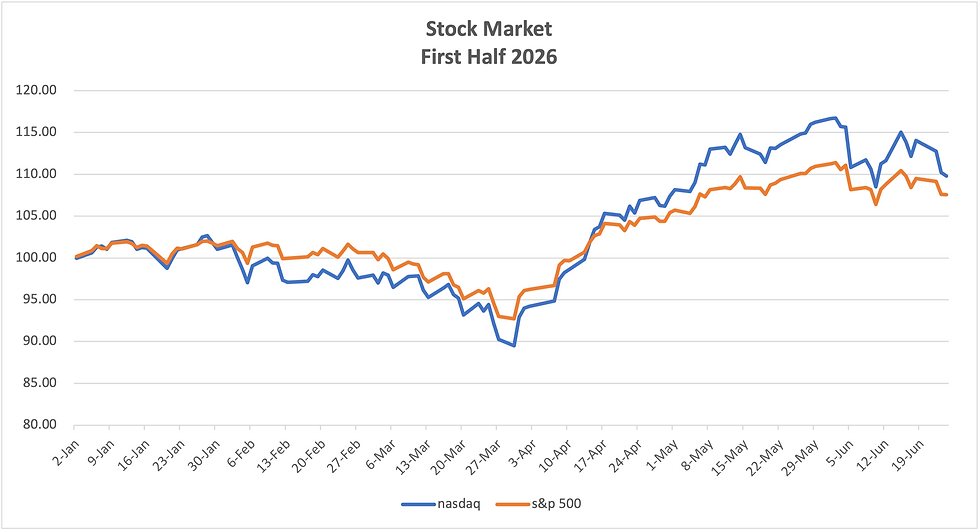
The Nasdaq has decline by 4.4% over the last month while the S&P 500 dropped 2.3%.
The chart below shows the recent erratic behavior of prices particularly in the Nasdaq. Over the last month, the Nasdaq had a decline of 7%, followed by a gain of 5% and then a drop of 4% (the blue line in the graph). That is a lot of volatility and an indication of instability.
Despite the recent decline in stock prices, on a year-to-date basis the S&P 500 is up 7% and the Nasdaq has climbed 9% this year.
The chart for the year shows the decline in prices in March due to the war in the Middle East.
At the beginning of April, Wall Street began to look past the situation in the Middle East and prices climbed rapidly in April and May.
The cease fire in Iran caused oil to drop by about $40 per barrel in the last month and a half. This should help slow down the recent rise in inflation. Today’s inflation report came in at 3.4% excluding food and energy – the highest level in three years.
Bullishness about corporate earnings is driving the stock market higher. Corporate earnings saw above average increases last year and the market is expecting even higher profit growth in 2026.
The expected interest rate adjustments from the Fed have changed significantly in the last three months. Previously, the market was expecting one or two rate cuts this year from the Fed. Due to inflationary pressures, the market is now expecting one or two rate increases.
SUMMARY
The bull market in stocks is still running at present. Volatility has increased recently particularly in the tech sector, but most indices are sitting on solid gains over the last six months.
Oil prices have decreased significantly in the last few weeks, and interest rates seem to have stabilized. Corporate profits continue to show very strong growth.
In the late stages of the bull market in the late 1990’s where the Nasdaq tripled in a few years, volatility was very high. The Nasdaq rose and fell many times by more than 30% up and down.
It appears that this bull still has room to run.
Stay Disciplined My Friends,
Phil
Disclaimers The Beyond Buy & Hold newsletter is published and provided for informational and entertainment purposes only. We are not advising, and will not advise you personally, concerning the nature, potential, value, or suitability of any particular security, portfolio of securities, transaction, investment strategy or other matter. Beyond Buy & Hold recommends you consult a licensed or registered professional before making any investment decision.
Investing in the financial products discussed in the Newsletter involves risk. Trading in such securities can result in immediate and substantial losses of the capital invested. Past performance is not necessarily indicative of future results. Actual results will vary widely given a variety of factors such as experience, skill, risk mitigation practices, and market dynamics.
%20(1).png)
